





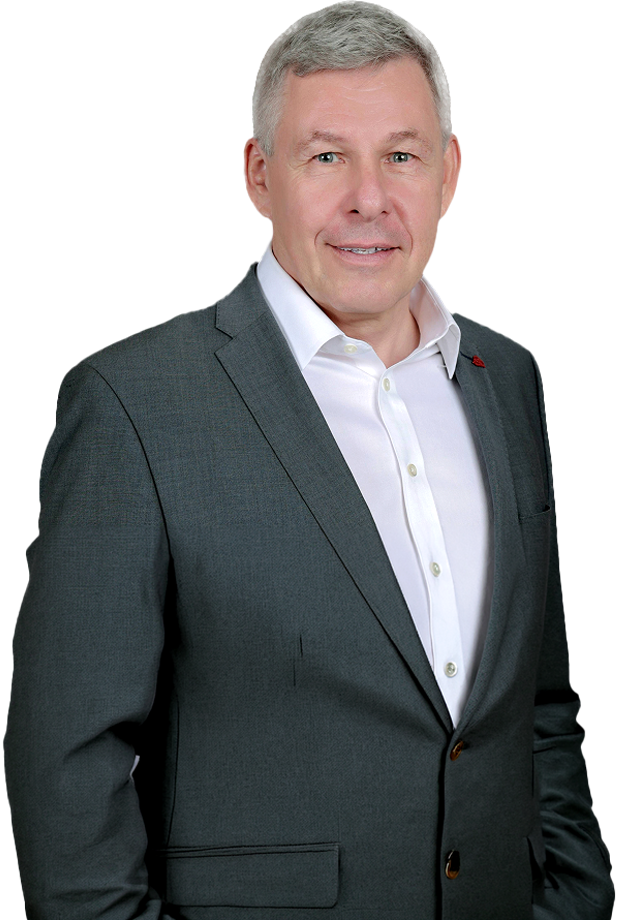



Our story of growth has been five decades in the making, with much to show for it; but, in recounting that long and distinguished history, the 2025-26 financial year (FY26) will stand out as a point of transition towards a broader ambition. The landmark shift from a private limited liability company owned by the Al Saady family, the Group’s Saudi founding partner, and the Grünenfelder family, its Swiss founding partner, to a publicly listed company represents a significant milestone in the strategic evolution of CGS, and, in that light, we extend a warm welcome to all our shareholders new and old.
FY26 also marked the highest order intake in the Group’s history, reaching X 588 Mn., while backlog increased by X 110.5 Mn., providing strong visibility over future revenue conversion and supporting the Group’s medium-term growth agenda. Against this backdrop, CGS enters its next phase of development with growth increasingly tied to several of Saudi Arabia’s own strategic priorities. Our future outlook extends to a grander vision that includes the Kingdom’s ambitious diversification objectives, with CGS already operating across several strategic demand areas, including food security, cold-chain infrastructure, energy and industrial applications, labour accommodation developments, defence localisation, and specialised healthcare solutions. Far from being abstract points of alignment, these are sectors in which CGS has built capabilities over many years through engineering expertise, local manufacturing, product development, and execution. This accumulated experience positions the Group to participate in sustained, structurally driven demand growth as these markets continue to evolve. It is our intention, in presenting this inaugural annual report post-listing, to illustrate precisely how that strategy will be actioned over the coming years.
As momentous as the Initial Public Offering (IPO) proved, FY26 was also, in many ways, a year of continuity, with the Group delivering strong overall performance on a solid foundation that had been built and reinforced over many years. At the same time, the year was also shaped by a planned leadership transition, with then Chief Executive Officer (CEO) Peter Faerber stepping down from executive responsibilities following nearly a decade of leadership, and Ruban Bilen assuming the role after serving as Group Chief Financial Officer (CFO) for several years. On top of these developments, the reporting period saw heightened geopolitical tensions across the region contribute to shipping delays, softer customer ordering activity, and short-term business uncertainty during the latter part of the fiscal year.
While the financial review section C 02 of this report will discuss the year’s performance in detail, we take this opportunity to provide to our valued investors greater insight into the nature of our business, which, due to its breadth and integrated operating model, may not always be immediately intuitive at first glance.
It must be noted at the outset that CGS is not a single-product industrial company; nor is it a collection of disparate business lines. It operates as an integrated engineering and cold-chain solutions platform spanning manufacturing, infrastructure delivery, and life cycle services. Importantly – and this needs some emphasis in order to dispel a not uncommon misconception – CGS does not provide transport services itself, but rather the specialised refrigeration and hardware solutions that enable temperature-controlled logistics operators to function efficiently. Because our strategy is often expressed through four distinct operating segments, the business can at first glance appear somewhat fragmented. In reality, these segments – namely, Automotive Solutions, Stationary Refrigeration, Customised Solutions, and Aftermarket Services – function as an interconnected system, with each complementing the others. Customised Solutions, in particular, reflects the extension of engineering and manufacturing expertise developed through decades of refrigeration expertise into adjacent applications and industries.
The Automotive Solutions segment remains the bedrock of our operations. As a market leader in temperature-controlled transport, this segment provides scale, consistency, and a broad installed base, the last of which is critical not just for revenue generation but also as a driver of demand for aftersales services. While performance during the reporting period reflected some normalisation in market share and some delays due to the ongoing regional conflict, the Automotive Solutions segment continues to be a stable core of the business.
Stationary Refrigeration occupies a different part of the value chain, providing cold-storage and processing infrastructure that supports food production, logistics, and industrial applications. While margins are typically lower due to the project-based nature of the work, the segment remains an important growth platform and a key contributor to broader market development.
The Customised Solutions segment, meanwhile, represents perhaps the most significant shift in our growth profile. Historically, CGS has been concentrated in cold-chain applications. The Customised Solutions segment has allowed us to extend our engineering and manufacturing capabilities into adjacent applications, including oil and gas, defence, and medical transport solutions. These bespoke projects are more complex and have longer development cycles, but they also help unlock new revenue streams and, importantly, new markets. Defence-related applications, in particular, carry the potential for export-led growth over time, presenting new opportunities and positioning CGS beyond its traditional geographic footprint.
Completing the model is Aftermarket Services, which includes maintenance, repair, and, increasingly, technology-enabled monitoring. At present, this segment remains somewhat underdeveloped relative to the size of the installed base with respect to Stationary Refrigeration, though it is also the highest-margin component of the business. Expanding service coverage, particularly in Stationary Refrigeration, is therefore a key strategic priority. We are optimistic that, over time, this will enhance profitability while also strengthening customer retention, creating a more resilient revenue mix in the long run.
These four segments collectively form a system that is largely self-reinforcing. Infrastructure drives demand for temperature-controlled transport solutions; transport expands the installed base; and that installed base generates recurring service opportunities over time. Customised Solutions, meanwhile, extend the Group’s reach into more specialised applications requiring increasingly sophisticated engineering and manufacturing capabilities. Underpinning this model is CGS’s accumulated Saudi-based technical expertise, which continues to support innovation within existing applications while enabling expansion into new sectors and solution categories. Understanding this interaction is central to understanding how CGS creates value.
To briefly touch on the performance of each of these segments during the year, growth in Customised Solutions and Stationary Refrigeration was strong, supported by increased demand, with Customised Solutions in particular benefiting from a record level of order intake. Automotive Solutions and Aftermarket Services experienced more modest performance, influenced primarily by a normalisation of market share levels, market dynamics, customer ordering cycles, and external factors such as supply chain disruptions due to geopolitical tensions. These pressures reflected a combination of customer caution, delayed ordering cycles, supply chain disruption, and geopolitical uncertainty, rather than any deterioration in the Group’s long-term structural demand drivers, which reveals a “recession proof” quality inherent to our business. Prolonged geopolitical disruption may, of course, affect the timing of customer investment decisions, but the underlying need for cold-chain infrastructure remains non-discretionary, and, in fact, will likely increase and accelerate demand in the mid to long term as the region looks to enhance its self-sufficiency.
The Group continues to plan across multiple macroeconomic scenarios and retains the flexibility to adjust operations accordingly, with a clear focus on preserving profitability and cash flow through sustained, disciplined execution. From a profitability perspective, margins remained broadly stable during the year, with a slight compression driven by changes in segment mix. As the contribution from lower-margin, project-based work increases, this effect is to be expected. However, this should be offset over time by the growth of higher-margin service activities and the scaling of more complex engineered solutions. The second half of FY26 also saw a broader tightening in market liquidity across several sectors in the Kingdom, contributing to slower customer decision-making and longer ordering cycles in parts of the market.
Looking ahead, CGS’s growth trajectory is tied to both internal execution and external tailwinds. In the near term, Automotive Solutions is expected to develop broadly in line with the overall market, while Stationary Refrigeration continues to benefit from sustained longer-term investment commitments in logistics and cold-chain infrastructure. Aftermarket Services, meanwhile, represents a significant opportunity to increase the share of recurring, higher-margin revenue, supported by an expanding installed base. Customised Solutions, on the other hand, is expected to become an increasingly important contributor to the Group’s growth profile, with a particular focus on oil and gas, medical applications, and the gradual development and monetisation of defence-related opportunities.
Over the medium term, the Group is positioned to extend its reach beyond the domestic market. Certain segments, especially Customised Solutions, are inherently exportable, and the development of internationally relevant capabilities will be a major area of focus going forward. This will be supported by continued investment in engineering, product development, and operational capability, alongside a disciplined approach to capital allocation. Importantly, the Group’s strong and debt-free balance sheet provides the financial flexibility to pursue these ambitions while maintaining a prudent approach to growth.
The broader operating environment remains favourable. On top of the Saudi Vision 2030 agenda being directly aligned with the very infrastructure that CGS supports, regulatory developments in food safety and cold chain compliance are also set to further increase demand by legally mandating temperature-controlled storage and transport, which will position CGS as a critical enabler of growth.
The new financial year will see the Company focus sharply on executing this strategy, by scaling what works, strengthening what needs more work, and maintaining the discipline required to deliver sustainable, long-term value. The journey ahead promises to be as eventful as it is rewarding. We trust that our investors will stay with us every step of the way.
Peter Faerber
Outgoing Chief Executive Officer
Ruban Bilen
Incoming Chief Executive Officer