







Year in review
The 2025-26 fiscal year that ended on 31 March 2026 (henceforth referred to as FY26) marked a period of normalisation and transition for CGS, following an exceptionally strong FY25 that saw a higher-than-average market share in the Automotive Solutions segment. Reported revenue in FY26 declined to X 477 Mn. from X 504 Mn. year-on-year, driven primarily by a moderation in Automotive Solutions volumes subsequent to the unprecedented performance during the prior year. Other contributing factors included delays in customer orders and shipment disruptions during the final weeks of the fourth quarter, which affected the timing of revenue recognition. Demand conditions also softened towards the latter part of the year, as customers adopted a more cautious investment approach amid growing geopolitical uncertainty and tighter market liquidity.
For CGS, performance during the year under review was shaped by a shift in segment mix. As mentioned, Automotive Solutions moderated after a period of elevated market share, while the Stationary Refrigeration and Customised Solutions continued to grow, supported by larger project activity, deeper engagement with tier-one customers, and continued expansion within existing application areas. This evolving mix reflects a gradual progression towards a more diversified engineered solutions portfolio.
Given that developments towards the end of the year deferred a portion of expected revenue into FY27, CGS’s performance during the reporting period should be viewed in the context of the Company’s project-based operating model, where the conversion of backlog into reported revenue is greatly influenced by execution timelines and customer readiness. Against this backdrop, CGS entered FY27 with a strong backlog of ~X 300 Mn., providing a reassuring degree of visibility over near-term revenue in the Customised Solutions and Stationary Refrigeration segments.
As discussed elsewhere in this report, FY26 also marked CGS’s listing on the Saudi Main Market. Being a secondary offering, the Initial Public Offering (IPO) did not generate proceeds for the Company; however, the listing was significant in that, being an institutional move, it served to enhance governance, market visibility, and organisational readiness as CGS positions itself for its next phase of growth.
Revenue and segment performance
CGS’s revenue profile reflects the characteristics of a multi-segment engineering business, where each segment operates under a distinct model, while simultaneously complementing each other. Movements in total revenue are, therefore, best understood through changes in segment mix, project timing, and execution cycles, rather than as a single, underlying trend.
Automotive Solutions, historically the largest contributor to revenue, declined during FY26 following the aforesaid normalisation in market share. Over the longer term, the segment continues to benefit from structural demand drivers including population growth, food security priorities, increasing cold-chain requirements, and tighter regulation aimed at reducing food waste. The Automotive Solutions segment’s revenue decline during the reporting period was also affected by delays in customer orders, and shipment disruptions towards year-end. It must be noted that these factors primarily influenced the timing of deliveries and, consequently, revenue recognition, and does not necessarily indicate a material deterioration in the segment’s long-term structural demand profile.
Stationary Refrigeration continued to expand during FY26, with further investment in engineering capabilities, particularly in processing applications, contributing to stronger customer confidence and increased market penetration. Revenue in this segment is linked to project milestones and can, therefore, vary across periods depending on the timing of execution and handover. The increased contribution during the year reflects both strong project activity and conversion of backlog.
Customised Solutions also recorded continued growth, driven by expanded penetration of the oil and gas sector. While still growing from a small base, the segment is becoming a key driver of the Group’s growth profile, reflecting the gradual expansion of its engineering and manufacturing capabilities into more specialised and increasingly sophisticated applications.
Aftermarket Services experienced lower activity during the year, reflecting softer service volumes in certain areas of the business and the still-developing scale of the Stationary Refrigeration segment portfolio. This notwithstanding, CGS continues to maintain a leading position in the Automotive aftersales services subsegment through its broad service network across the Kingdom. The segment remains strategically important due to its recurring revenue characteristics and long-term margin potential as the installed base continues to expand.
Collectively, segment performance points to a business in transition, from a predominantly automotive-led model towards a more balanced portfolio comprising standardised products, project-based infrastructure, and specialised engineering solutions, each contributing differently to revenue growth and its timing.
Revenues over the past five financial years including FY26:

|
FY26 X |
FY25 X |
FY24 X |
FY23 X |
FY22 X |
||||||
| Revenue | 477,143,568 | 504,337,619 | 349,147,250 | 256,845,261 | 264,781,576 | |||||
| Cost of revenue | (372,932,676) | (388,613,694) | (265,310,966) | (201,005,918) | (219,440,364) | |||||
| Gross profit | 104,210,892 | 115,723,925 | 83,836,284 | 55,839,343 | 45,341,212 | |||||
| Net profit | 46,602,502 | 66,219,323 | 45,048,954 | 25,360,924 | 30,088,370 |
Revenue remained overwhelmingly domestic in nature, with the Kingdom accounting for more than 98% of total revenue in FY26.
Detailed information on segment revenue and revenue by geographic market is provided in Notes 32 and 18, respectively, to the consolidated financial statements.
Backlog, order intake, and revenue timing
For CGS, backlog and order intake provide a more reliable indication of underlying activity than reported revenue in any single period. As an increasingly project-based engineering business, revenue recognition, as mentioned earlier, is inherently tied to project milestones, delivery schedules, and customer readiness, all of which can shift revenue timing across reporting periods.
During FY26, the company recorded a significant increase in backlog to ~X 300 Mn., supported by a record order intake of X 588 Mn., with Customised Solutions being a key driver alongside continued momentum in Stationary Refrigeration. This reflects sustained demand for larger, project-based installations and specialised applications. The Company’s localisation capabilities and ability to deliver turnkey solutions manufactured within the Kingdom also continue to support customer demand across several strategic sectors.
Delays in shipment, chassis availability, and customer order placement in the final weeks of FY26 resulted in the deferral of certain project completions. These were influenced by a combination of supply chain constraints, customer caution in placing orders, and external disruptions associated with geopolitical tensions during the latter part of the year.
It must also be noted that backlog composition varies by segment, with shorter conversion cycles in Automotive Solutions and longer execution timelines in Stationary Refrigeration and Customised Solutions. This highlights the importance of assessing performance over multiple periods, as revenue recognition may not align with order intake within a single reporting cycle.
Overall, the year-end backlog position supports management’s outlook, indicating largely sustained underlying demand and a pipeline of projects expected to drive revenue conversion in FY27 and beyond.
Margins and profitability
Revenue, net profit, and gross margin trend
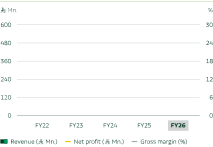
Despite the lower revenue and shift in segment mix, CGS maintained underlying profitability in FY26. Gross margin remained broadly stable at approximately 22% compared to nearly 23% in the previous year, reflecting the resilience of our business model as the composition of revenue evolved.
Margin movement during the year was driven by mix effects rather than any operational weaknesses. A higher contribution from Stationary Refrigeration, which carries a relatively lower margin profile due to its project-based, on-site nature, diluted margins on a blended basis. Automotive Solutions continues to benefit from scale and standardisation, while margins within Customised Solutions can vary significantly depending on project scope, technical specifications, and application complexity. Aftermarket Services remains the highest-margin segment, although the long-term opportunity for scale expansion remains more pronounced within the Stationary Refrigeration segment portfolio.
At the operating level, profitability was impacted by an increase in overheads, with general and administrative expenses rising to X 34.8 Mn. from X 32.4 Mn. This reflects continued investment in organisational capability, including talent, governance, and systems, associated with the Company’s transition to a listed entity. Higher bad debt provisions, driven primarily by the Company’s expected credit loss (ECL) methodology rather than realised losses, also contributed to the increase in operating costs during the year.
As a result, operating margin moderated to approximately 11% from ~14% in FY25. This reflects the combined effect of segment mix and a higher cost base associated with transitioning to a listed entity, rather than deterioration in core profitability. Overall, CGS demonstrated the ability to sustain earnings quality while progressing towards a more diversified and project-driven revenue profile.
Working capital and cash conversion
CGS’s cash conversion profile reflects the dynamics of a project-based engineering business. While the Company operates with a relatively capex-light model, growth can absorb working capital, as materials, labour, and execution costs are incurred ahead of billing and collection.
Trade receivables increased to X 75.1 Mn. from X 64.5 Mn., while contract assets stood at X 18.3 Mn. at year-end, consistent with higher levels of project activity and invoicing towards year-end. Despite the increase in receivables, collection performance remained healthy, with days sales outstanding (DSO) levels broadly stable at 53 days, while receivables more than 90 days past due remained at 24% of total trade receivables. Collection cycles during the second half of the year were also influenced by broader liquidity conditions across parts of the market.
Inventory declined to X 74.9 Mn. from X 78.2 Mn., despite continued project activity, indicating improved inventory discipline and more efficient working capital management. This is notable given the Company’s reliance on components, materials, and imported equipment across its core segments.
Trade payables increased to X 42.6 Mn. from X 31.7 Mn., while contract liabilities decreased to X 35.1 Mn. from X 45.4 Mn. These movements reflect changes in project execution and billing cycles, with a greater share of activity captured in receivables and contract assets, and a lower level of customer advances at year-end.
Overall, CGS maintained a healthy working capital position during FY26, despite executing a larger and more complex order book. The Company’s cash conversion profile continues to reflect the operating characteristics of a project-based business, with working capital movements aligned to project execution, billing, and collection cycles.
Working capital
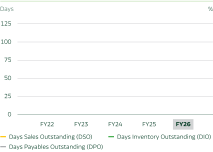
Cash conversion cycle improved to approximately 92 days in FY26 from 91 days in FY25, supported by improved inventory discipline and stable collection performance.
Balance sheet, funding, and capital position
CGS closed FY26 with a strong balance sheet and no debt, providing financial flexibility as it enters its next phase of growth as a listed company. Cash and cash equivalents increased to X 87.7 Mn. from X 68.6 Mn., while total liabilities remained broadly stable at X 136.6 Mn.
Equity increased to X 200.1 from X 162.7 Mn., driven by increasing retained earnings during the year. Reflecting these developments, the Group’s current ratio improved to 2.49x from 2.12x in FY25, reinforcing its strong liquidity position and capacity to meet short-term obligations.
CGS’s capital position remains conservative, characterised by no financial leverage and a strong liquidity position. This provides resilience against working capital fluctuations, geopolitical uncertainty and broader cyclical pressures, while preserving the financial flexibility to support the Company’s long-term strategic objectives and the pursuit of future growth opportunities.
Financial position over the past five years including FY26:
|
FY26 X |
FY25 X |
FY24 X |
FY23 X |
FY22 X |
|
| Current assets | 272,863,164 | 232,911,891 | 228,451,169 | 154,302,304 | 149,088,198 |
| Non-current assets | 63,929,181 | 65,597,563 | 45,168,300 | 31,125,927 | 28,089,885 |
| Total assets | 336,792,345 | 298,509,454 | 273,619,469 | 185,428,231 | 177,178,083 |
| Current liabilities | 109,686,676 | 109,635,807 | 140,213,766 | 88,695,291 | 103,069,476 |
| Non-current liabilities | 26,971,762 | 26,159,522 | 18,671,489 | 17,239,713 | 16,832,722 |
| Total liabilities | 136,658,438 | 135,795,329 | 158,885,255 | 105,935,004 | 119,902,198 |
During FY26, the Company did not have any outstanding bank loans or other borrowings. Also, the Company did not issue any transferable debt instruments, convertible instruments, warrants, or subscription rights, nor were there any transfers, grants, redemptions, purchases, or cancellations of such instruments during the year.
Outlook


As already noted, CGS enters FY27 with a strong backlog of approximately X 300 Mn., providing visibility over revenue conversion in the near term. Activity is expected to be supported by continued momentum in Stationary Refrigeration and Customised Solutions, alongside a more normalised contribution from Automotive Solutions.
Revenue timing is likely to remain a key consideration, particularly as a greater share of the order book comprises larger and more complex projects. A portion of the delays experienced in FY26 is expected to convert in the new financial year, although execution timelines, customer readiness, and delivery schedules may continue to influence the timing of reported revenue.
Segment mix will remain an important determinant of overall margin levels. While growth in Stationary Refrigeration and Customised Solutions supports diversification, it may also affect blended margins depending on project scope and execution. Aftermarket Services continues to represent a longer-term opportunity to enhance margin quality as the installed base expands.
Overall, CGS is positioned for continued growth, supported by a strong balance sheet, record backlog, sustained sector demand, and investments in stronger foundations of a public company platform. As the business scales, disciplined working capital management and capital allocation will remain critical to translating growth into sustainable cash generation.